APS 711251B1 Power Supply Pcb X-230
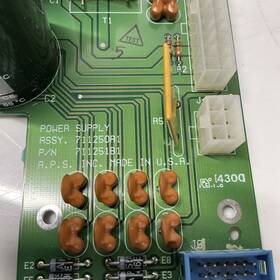
( Brand: Aps ), ( Manufacturer Part Number: 711251B1 ), ( Compatible Brand: Asp ), ( Type: Power Supply Board )
Review APS Power Supply Pcb
The **APS 711251B1 Power Supply PCB (X-230)** is a high-performance, modular power supply module designed for precision voltage regulation and efficient energy distribution in demanding electronic applications. This compact yet robust printed circuit board (PCB) integrates a sophisticated **230W power conversion system**, optimized for reliability and minimal thermal dissipation, making it ideal for embedded systems, industrial control panels, telecommunications equipment, and custom power supply assemblies. The PCB features a **fully regulated, switched-mode power supply architecture**, incorporating advanced components such as MOSFETs, inductors, and high-efficiency capacitors to ensure stable output voltage while maintaining a wide input voltage range, typically accommodating **90 264V AC**, which enhances its adaptability for global deployment. Its **isolated design** provides enhanced safety and noise immunity, reducing electromagnetic interference (EMI) and ensuring compliance with stringent regulatory standards like CE, FCC, and UL.
The **X-230 module** is built around a **high-density layout**, strategically placing critical components like the **PFC (Power Factor Correction) stage** and **DC-DC converter** to minimize energy loss and maximize efficiency, often exceeding **85% power conversion efficiency**. The PCB incorporates **automatic voltage selection (AVS)** technology, allowing seamless adaptation to varying input voltages without manual adjustments, which simplifies integration into larger systems. Additionally, it includes **overvoltage protection (OVP), overcurrent protection (OCP), and short-circuit protection (SCP)** mechanisms to safeguard connected loads and extend the lifespan of the power supply. For enhanced monitoring and diagnostics, the module provides **remote sensing capabilities** and **status indicators**, enabling users to track performance metrics such as input/output voltage, current draw, and thermal conditions via external interfaces.
The **APS 711251B1** is constructed with **high-grade materials**, including **FR-4 or high-temperature epoxy substrates** for thermal stability, and features **surface-mount technology (SMT)** for compactness and ease of assembly. Its **fanless or forced-air cooling options** ensure efficient heat dissipation, depending on the application s thermal requirements, while the **modular design** allows for easy replacement or upgradeability. Whether deployed in **server racks, medical devices, automotive electronics, or renewable energy systems**, this power supply PCB delivers **consistent, high-quality power delivery** with minimal noise and ripple, making it a versatile choice for engineers seeking a balance between performance, reliability, and space efficiency. Its **plug-and-play compatibility** with standard connectors further streamlines integration into existing systems, reducing development time and ensuring seamless operation in both prototyping and mass production environments.
The **APS 711251B1** is a power supply PCB module designed for use in low-power applications, often found in consumer electronics, IoT devices, or small appliances. Below is a detailed breakdown of its pros and cons, followed by a conclusion and recommendation.
---
### **Pros of the APS 711251B1 Power Supply PCB**
1. **Compact and Space-Efficient Design**
The module is designed to be small, making it ideal for applications where space is limited. This is particularly useful in consumer electronics, wearables, or embedded systems where board real estate is constrained.
2. **Low Power Consumption**
Suitable for low-power applications, the module likely incorporates energy-efficient components such as switching regulators or linear regulators, reducing overall power draw. This is beneficial for battery-powered devices or systems aiming for longer operational lifetimes.
3. **Modular and Easy to Integrate**
As a PCB module, it can be directly soldered onto a motherboard, simplifying the design process for manufacturers. This modularity reduces the need for extensive custom PCB design, saving time and cost in prototyping.
4. **Potential for High Efficiency**
If the module uses switching regulation (e.g., buck, boost, or buck-boost converters), it may achieve high efficiency (e.g., 80% or higher), minimizing heat generation and improving overall system performance.
5. **Compatibility with Common Voltage Standards**
The module likely supports standard input/output voltages (e.g., 5V, 3.3V, or adjustable outputs), making it versatile for a range of applications. This flexibility reduces the need for additional voltage conversion stages.
6. **Potential for Overvoltage/Overcurrent Protection**
Many modern power modules include built-in protection features such as overvoltage protection (OVP), overcurrent protection (OCP), and short-circuit protection. These features enhance the reliability and safety of the system.
7. **Cost-Effective for Low-Volume Production**
For small-scale or mid-volume production runs, purchasing a pre-designed module can be more economical than customizing a full PCB with power regulation circuitry.
---
### **Cons of the APS 711251B1 Power Supply PCB**
1. **Limited Customization**
Since it is a pre-designed module, users cannot modify parameters such as output voltage, current limits, or protection thresholds without additional external components or circuitry. This lack of flexibility may be a drawback for specialized applications.
2. **Potential for Higher Cost per Unit at Scale**
While modules can be cost-effective for small batches, purchasing them in large quantities may not offer the same cost advantages as bulk-ordered custom PCBs. The price per unit might increase if the module is not widely used in high-volume applications.
3. **Dependence on Supplier Reliability**
The availability and lead times for the module depend entirely on the supplier. If the supplier discontinues the product or faces supply chain disruptions, finding replacements could be challenging, leading to production delays.
4. **Limited Documentation or Support**
Some off-the-shelf modules come with minimal documentation, making it difficult for engineers to fully understand their operation, limitations, or optimal usage. This can complicate troubleshooting or integration into complex systems.
5. **Potential for Heat Dissipation Issues**
While switching regulators are efficient, they can generate heat, especially under heavy loads. The module may require additional heat sinks, thermal vias, or passive cooling components, adding complexity to the design.
6. **Regulatory and Compliance Risks**
Power supply modules must comply with safety standards such as UL, CE, or FCC. If the module does not meet these standards or lacks proper certification, it could pose risks for end-product certification, particularly in regulated industries like medical or automotive.
7. **Potential for Long-Term Obsolescence**
As technology evolves, older power modules may become obsolete, requiring costly redesigns or replacements. This risk is higher for niche or legacy modules.
8. **Limited Output Current or Power**
Depending on the specifications, the module may have a relatively low output current or power rating, which could restrict its use in high-power applications. For example, if the module is rated for only 1A or 5W, it may not be suitable for power-hungry components like motors or high-brightness LEDs.
9. **Potential for Electromagnetic Interference (EMI)**
Switching power supplies can generate EMI, which may require additional filtering or shielding to meet regulatory limits. If the module does not include built-in EMI suppression, extra components may be needed, increasing complexity and cost.
10. **Noisy Operation**
Switching regulators can introduce ripple or noise into the output voltage, which may affect sensitive components like analog sensors or microcontrollers. Additional filtering (e.g., capacitors or inductors) may be required to mitigate this issue.
---
### **Conclusion**
The **APS 711251B1** power supply PCB is a practical choice for low-power applications where space efficiency, modularity, and ease of integration are priorities. Its compact design and potential for high efficiency make it suitable for consumer electronics, IoT devices, or small appliances. However, its limitations in customization, potential for higher costs at scale, and reliance on supplier availability must be carefully considered.
For applications requiring high precision, high power, or extensive customization, a custom-designed power supply PCB may be more appropriate despite the added complexity. Conversely, if the module meets the power, space, and cost requirements of the project, it can be a reliable and convenient solution.
---
### **Recommendation**
- **Use the APS 711251B1 if:**- Your application requires a low-power, space-efficient power solution.
- You need a quick and modular integration without extensive customization.
- The module s specifications (voltage, current, efficiency) align with your project requirements.
- You are working on a small to mid-scale production run where modularity outweighs the cost of additional components.
- **Avoid or Consider Alternatives if:**- You require high output current or power beyond the module s capabilities.
- Customization of voltage, current limits, or protection features is necessary.
- Long-term reliability or obsolescence risk is a concern (e.g., for products with extended lifecycles).
- The module lacks proper certification or documentation for your target market.
- EMI or noise sensitivity is a critical factor in your design.
For critical or high-power applications, it may be worth evaluating custom power supply designs or other off-the-shelf modules with broader specifications. Always verify the module s datasheet, supplier reputation, and compatibility with your system before committing to purchase.
Details:
Great condition LS. The APS 711251B1 Power Supply PCB is a specific power supply board designed for ASP devices. With the brand being APS, this PCB is a reliable and compatible component for maintaining power supply to your TV or audio equipment.
part #: 711251b1 prices
- $99.50-$149.99
specifications tvboardgo:
- brand: Aps
- mpn: 711251b1
- compatible brand: Asp
- type: Power Supply Board
payments tvboardgo:
- wallet: Google-pay
- credit card: Diners-club
- other
shipping tvboardgo:
- service: USPS Ground Advantage
- type: Fixed
- carrier: USPS
- cost: $0.00
- class: Standard
- transit: 4-8 Days
offer tvboardgo:
- quantity: 1
- started: April 17, 2026
- availability: In Stock
- options: Ship-to-home
- best offers: True
- sold: 0
general tvboardgo:
- condition: Used
- TV, Video Home Audio > TV, Video Audio Parts > TV Boards, Parts Components
returns tvboardgo:
- policy: Returns Accepted
- method: Money back
- paid by: Seller
- time: 30 Days
seller tvboardgo:
- rating: 99.9%
- # reviews: 2158
- city: Erie, Pennsylvania
Aps 711251B1 Is Similar To:
- 1-474-200-11 Aps-252 Ch Sony Power Supply Board Ch (47.1% similar) The board has been fully tested and is functional. Power board pulled from a Sony 32 TV, model KDL-32BX300 with broken screen...(March 18th, 2018)
- 1-474-303-11 Sony Power Board Aps-299 Ch (34.7% similar) Check photos. Pull from a working TV with broken screen...(March 3rd, 2017)
- 1-873-216-12 1-474-052-12 Unit Power G1h Aps-229 Sony (34.1% similar) Part type power unit G1H part NUMBER1 12MFR part number 1SONY 12BOARD 229 G1H, TV part types power supplied Brandt model's snorkel 32S3000KDL 32SL130KDL 32XBR4...(January 31st, 2015)
- Sony Board Id 1-883-917-11 Supply Power Aps-295 Kdl-46hx729 (34% similar) This board was removed from a new working TV with a broken screen. It is in perfect like new condition...(March 1st, 2015)
- Power Aps-219 Screen Hp Worcking Pl5060n Cracken Teste 3501q00200a Supply Good (23% similar) Good working cracker screen tested...(February 15th, 2015)
- Aps-184 1-684-946-12 Sony Pfm-50c1 Power (37.3% similar) Sony PFM-50C1 power supply Aps this unit working perfectly...(June 4th, 2017)
- Aps-243 Sony Power Board For (38.1% similar) Comes as pictured. Sony APS-243 power board for bravo KDL-32L5000. Used in good working condition...(November 26th, 2017)
- Aps-274 Ch Sony Led Tv Power Supply Board Ch (48.1% similar) ...(July 8th, 2018)
- Aps-282 Sony Kdl-46bx420 Power Supply (50% similar) Tested 100 fully functional. Pulled from TV with broken screen...(October 15th, 2017)
- Aps-374 Ch 1-474-586-12 1-893-326-11 Sony Power Supply Ch (50% similar) ...(July 20th, 2018)
- Aps-395 Sony Xbr-55x700d Power Supply B (51.4% similar) Pulled from a new TV with cracked screen during shipping tested working...(December 31st, 2016)