CLEVITE 2N176 Transistor TO-3
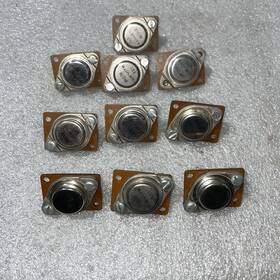
( Brand: Clevite ), ( Manufacturer Part Number: 2N176 ), ( Compatible Brand: Universal ), ( Type: Transistor )
Review CLEVITE Transistor To-3 Used In Various Applications Lot
The **Clevite 2N176** is a robust, high-performance **TO-3 metal-can transistor** designed for demanding industrial, automotive, and high-power switching applications. Part of the early **2N series** of power transistors, this device was originally manufactured by Clevite Transistor Products (later acquired by Motorola and now part of the broader semiconductor industry), and it remains a sought-after component among vintage electronics enthusiasts, restoration specialists, and power electronics hobbyists. Encased in a **TO-3 package**, the 2N176 features a **three-terminal metal can** with a robust, heat-dissipating base, making it ideal for applications requiring reliable high-current handling and thermal stability. This transistor is a **PNP bipolar junction transistor (BJT)**, meaning it conducts current when its base is reverse-biased relative to its emitter, making it particularly useful in high-power switching circuits, motor drivers, and amplifier stages where efficient heat dissipation is critical.
The **2N176** is capable of handling **continuous collector currents up to 15 amperes** and **peak currents as high as 30 amperes**, depending on proper heat sinking and operating conditions. Its **collector-emitter voltage rating of 60 volts** allows it to operate in medium-voltage applications, such as relay drivers, solenoid controls, and low-voltage motor commutation circuits. The transistor s **gain (hFE) ranges from 20 to 100**, providing sufficient current amplification for switching and linear amplification tasks while maintaining stability in high-power scenarios. Its **maximum power dissipation of 100 watts** (with adequate heat sinking) ensures reliable performance in environments where thermal management is essential, though prolonged operation near this limit may require additional cooling measures.
Originally designed for **automotive and industrial electronics**, the 2N176 was commonly used in **ignition systems, alternator regulators, and high-current switching relays** in older vehicles and machinery. Its **durability and thermal resilience** make it a favorite for **restoration projects**, particularly in classic cars where original components are difficult to replace. Beyond automotive use, the transistor finds applications in **high-power amplifier circuits, inverter designs, and even early computer peripherals**, where its robust construction and predictable performance were invaluable. The **TO-3 package** itself is a testament to its industrial-grade build, featuring a **screw-down terminal configuration** that ensures secure electrical connections and efficient heat transfer to external heatsinks.
For modern users, the **2N176** remains a fascinating piece of semiconductor history, offering a blend of **reliability, power handling, and historical significance**. While newer transistors may offer higher efficiency or integrated protection features, the 2N176 s **proven track record in high-stress environments** makes it a valuable addition to any collection of vintage electronics. Whether used in **restoration work, educational projects, or as a curiosity piece**, this transistor embodies the engineering prowess of mid-20th-century semiconductor technology, bridging the gap between analog power electronics and modern digital systems. Its **availability in both new and refurbished forms** ensures that enthusiasts can continue to experience its performance firsthand, making it a timeless component in the world of power electronics.
The **Clevite 2N176** is a power transistor in the TO-3 package, designed for high-voltage, high-current applications such as switching regulators, motor drivers, and amplifier circuits. Below is a detailed analysis of its pros and cons, followed by a conclusion and recommendation.
---
### **Pros of the 2N176 Transistor**
1. **High Voltage Rating**
The 2N176 can handle up to **600V** of reverse voltage (Vdr) and **10A** of continuous collector current, making it suitable for high-voltage applications where other smaller transistors would fail. This is ideal for industrial, automotive, or high-power switching circuits.
2. **Rugged Construction**
The TO-3 package is robust, designed for high-power dissipation (up to **100W** with proper heat sinking). This makes it durable in environments with thermal stress or mechanical handling.
3. **Wide Availability and Cost-Effectiveness**
As a legacy component, the 2N176 is still produced by multiple manufacturers (e.g., Clevite, Motorola, or modern equivalents like the **IRFZ44N** in some cases). While not as cheap as modern MOSFETs, it remains affordable for bulk purchases, especially in industrial or repair contexts.
4. **Compatibility with Older Schematics**
Many vintage or industrial circuits (e.g., old power supplies, motor controllers, or amplifier designs from the 1970s 1990s) were built around this transistor. Replacing it with a modern alternative may require redesigning the circuit, so sourcing the original part can save time and effort.
5. **Good Thermal Characteristics**
With a maximum junction temperature of **175 C**, it can operate reliably in high-temperature environments if adequately heat-sinked. This is useful in automotive or outdoor applications.
6. **Low Saturation Voltage (Vce(sat))**
At high currents, the 2N176 maintains a relatively low saturation voltage ( 0.5V 1V at 10A), which reduces power loss in switching applications compared to some bipolar transistors with higher Vce(sat).
7. **No Gate Threshold Issues**
Unlike MOSFETs, which require a gate charge to turn on, the 2N176 is a bipolar junction transistor (BJT) that turns on with a base current. This can simplify drive circuitry in some cases, though it may also introduce efficiency trade-offs.
---
### **Cons of the 2N176 Transistor**
1. **Lower Efficiency Compared to MOSFETs**
BJTs like the 2N176 are inherently less efficient than modern **power MOSFETs** (e.g., IRFZ44N, IRLB8743) in switching applications due to higher conduction losses and slower switching speeds. MOSFETs have lower on-resistance (Rds(on)) and faster switching, reducing heat and improving efficiency in PWM circuits.
2. **Slower Switching Speed**
The 2N176 has a typical switching frequency limit of ** 10 20 kHz**, which is slower than modern MOSFETs that can switch at **MHz frequencies**. This limits its use in high-frequency inverters, DC-DC converters, or RF applications.
3. **Higher Power Dissipation in Switching Modes**
Because BJTs require a base current to saturate, they spend more time in the active region during switching, leading to higher power loss compared to MOSFETs, which can be fully enhanced (turned on/off quickly with minimal loss).
4. **Sensitivity to Base Drive Requirements**
The transistor requires precise base current control to avoid saturation (which causes excessive power loss) or cutoff (which fails to switch properly). This can complicate driver circuit design, especially in high-power applications.
5. **Limited Modern Support**
While the 2N176 is still available, it lacks the advanced features of modern transistors, such as:- **Built-in protection** (e.g., MOSFETs often have integrated diodes for flyback protection).
- **Enhanced thermal management** (e.g., TO-247 or TO-220 packages with better heat dissipation).
- **Lower gate charge** (MOSFETs turn on/off faster with less energy).
6. **Potential for Latch-Up in High-Voltage Applications**
BJTs can suffer from secondary breakdown if not properly heat-sinked, leading to permanent failure. MOSFETs are generally more robust in this regard.
7. **Obsolete in Some Contexts**
While not entirely obsolete, the 2N176 is rarely the first choice for new designs. Engineers often prefer MOSFETs or IGBTs for modern power electronics due to their superior efficiency and control characteristics.
---
### **Conclusion**
The **2N176 is a reliable, high-voltage, high-current transistor** that remains useful in specific applications where its characteristics are advantageous:
- **Legacy circuit repairs** (e.g., restoring vintage equipment).
- **Industrial or automotive power switching** where its voltage rating is critical.
- **Low-frequency switching** (e.g., simple motor drivers or linear amplifiers).
- **Cost-sensitive bulk purchases** where modern alternatives are prohibitively expensive.
However, for **new designs, high-frequency switching, or efficiency-critical applications**, modern **MOSFETs (e.g., IRFZ44N, IRLB8743) or IGBTs** are superior choices due to their faster switching, lower conduction losses, and better thermal management.
---
### **Recommendation**
- **Buy the 2N176 if:**- You are repairing or maintaining older equipment that specifically requires it.
- Your application demands **>600V and 10A** with a simple BJT-based design.
- Cost is a primary concern, and you cannot redesign the circuit for a MOSFET.
- You are working in a **low-frequency switching** scenario (e.g.,
- **Avoid the 2N176 if:**- You are designing a **new power supply, inverter, or high-frequency circuit** (use a MOSFET instead).
- Efficiency is critical (MOSFETs will reduce heat and improve performance).
- You need **faster switching speeds or better thermal protection** (modern transistors offer these).
- The application benefits from **simpler drive circuitry** (MOSFETs can be driven with just a voltage signal).
**Alternatives to Consider:**- For **high-voltage, high-current switching:** **IRFZ44N (600V, 33A MOSFET)** or **IXFN60N10N (600V, 10A MOSFET)**.
- For **automotive or industrial use:** **IRLZ44N (logic-level MOSFET)** or **IXYS IGBTs** for even better performance.
- For **legacy compatibility:** Ensure the replacement matches the **voltage, current, and thermal characteristics** of the original part. Always verify with the manufacturer s datasheet.
Details:
Sockets included. All tested good let me know if nonfunctional. Ice leakage about 1 ma.
part #: 2n176 prices
- $12.00-$18.00
specifications tvboardgo:
- brand: Clevite
- mpn: 2n176
- compatible brand: Universal
- type: Transistor
payments tvboardgo:
- credit card: Discover
- wallet: Paypal
- other
general tvboardgo:
- condition: Used
- TV, Video Home Audio > TV, Video Audio Parts > TV Boards, Parts Components
returns tvboardgo:
- policy: Returns Accepted
- time: 30 Days
- paid by: Buyer
- method: Money back
seller tvboardgo:
- # reviews: 1245
- city: Richmond, California
- rating: 99.8%
offer tvboardgo:
- started: February 26, 2026
- availability: In Stock
- options: Ship-to-home
- best offers: True
- quantity: 1
- sold: 0
shipping tvboardgo:
- cost: $8.50
- carrier: USPS
- type: Fixed
- transit: 5-11 Days
- service: USPS Ground Advantage
- class: Standard